
September 28, 2026 Lumber News
Another week of decreases comes as demand seems to refuse to pick up the pace in nearly all sectors of lumber. The only ...

Lumber Notes March 2026
Welcome to another look at the lumber world!
If you followed the lumber market at all last year, you were sure to hear the word “tariff” in nearly every conversation. You may have even heard of “Section 232” and wondered what it meant. What is Section 232 and what does it mean for the lumber market? Section 232 of the Trade Expansion Act of 1962 is a statute that “…allows the President to impose restrictions on goods imports or enter into negotiations with trading partners if the US Secretary of Commerce determines, following an investigation, that the quantity or other circumstance of those imports ‘threaten to impair’ US national security” (www.congress.gov, “Section 232 of the Trade Expansion Act of 1962” accessed 12/24/25).
The Trump Administration has launched nine new Sec. 232 investigations as of the time of this writing. During the first Trump Administration, Commerce completed seven Sec. 232 investigations on the following commodities: aluminum, steel, automobile parts, uranium, titanium sponge, transformers and transformer components, and vanadium.
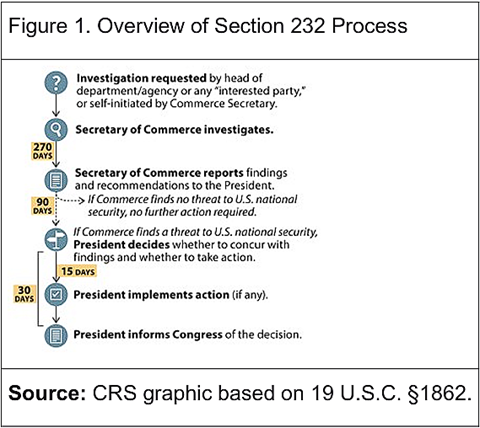
See figure 1 below to understand the Sec. 232 process.
When considering the effects of imports into the United States, the Secretary of Commerce and the President must consider:
“Defense. (1) domestic production required for projected U.S. defense needs; (2) capacity of domestic industry to meet such needs; (3) existing and anticipated availability of the human resources, products, raw materials, production equipment and facilities, and other supplies and services essential to U.S. national defense; (4) growth requirements of domestic industry and related supplies and services to meet U.S. defense needs and necessary conditions to assure such growth; and (5) the impacts of goods imports on U.S. industry and capacity to meet U.S. defense needs.
Economy. (1) ‘the impact of foreign competition on the economic welfare’ of domestic industry; and (2) the ‘displacement’ of U.S. products by ‘excessive imports’ causing effects including ‘substantial unemployment,’ decreases in government revenues, and/or loss of investment and skills” (www.congress.gov, “Section 232 of the Trade Expansion Act of 1962” accessed 12/24/25).
The phrase “national security threat” is not defined in Sec. 232, so there is controversy surrounding its definition and it is debated by governing bodies.
Exactly one year ago (in March of 2025) Trump announced the Section 232 investigation, to “determine the effects on the national security of imports of timber, lumber and their derivative products.” Commerce found a threat to U.S. national security and the restults of the investigation were released in the middle of October. As a result, a 10% tariff was imposed on imported wood products.
This is a basic outline for a complex subject but hopefully sufficiently detailed to help us understand what Section 232 is and how it can affect the lumber market.
Prices were rising sharply across all widths (with the exception of 2x12s) in the beginning of 2026 as reduced production drove prices upwards. The lack of movement in 2×12 was a puzzle, since it was unusual for one width to remain idle while the other widths were increasing sharply. There were larger one-week and one-month increases in January of 2026 than in all of 2025 in Southern Yellow Pine. This was largely due to many mills maintaining their reduced-level production numbers. As we had mentioned in articles prior, many mills cut production in quarter 4 of 2025 due to lack of demand and high inventory levels. Many mills have yet to bring back their normal production levels and in fact, some are even formally announcing that they will maintain this reduced production through quarter one of 2026.
Lower grades were hard to come by (due to sparse production) which drove prices up. Low grade SYP increased nearly $100 from September of 2025 to January 2026. The gap between #3 and #4 prices is continually shrinking. There is speculation that #4 SYP will eventually be a thing of the past (we will write on the reasons behind this in a later article).
A severe winter storm that moved through much of the South contributed to a slower pace at the end of January. Some mills anticipated the icy conditions and planned a holiday on Monday, January 26, which lowered production further, if just slightly.
Prices were also on the rise in SPF due to mill production cut backs. Demand at the beginning of 2026 was still lackluster so the increases seem to come solely from less supply rather than from increased demand.
At least partly due to the fact that Southern Yellow Pine prices were on the rise in the beginning of the year, Canadian mills sold more low grade 2×4 and 2×6 in the US than they had for several months before.
To whet your appetite we will briefly consider here an interesting dynamic that affects the SPF industry. British Columbia has steadily been declining in lumber production. From 2014 through 2018 annual production totaled nearly 12.4 billion board feet. Compare that with 2025, in which total production was just over 6 billion board feet. Contrast this with eastern Canada, which through September of 2025 produced just over 10 billion board feet, while BC only produced 4.7 billion board feet (through September of 2025). Eastern Canada accounted for just over 68% of total Canadian output in 2025. It wasn’t always this way, however.
What we are seeing is a shift of production away from western Canada and toward eastern Canada. In 1989, for example, total Canadian production was just over 24.5 billion board feet. 62% of that came from British Columbia, or just over 15 billion board feet. This decline of production is not limited to BC, as the western United States has a similar story. What caused this decline? We will dive into this phenomenon in a later article.
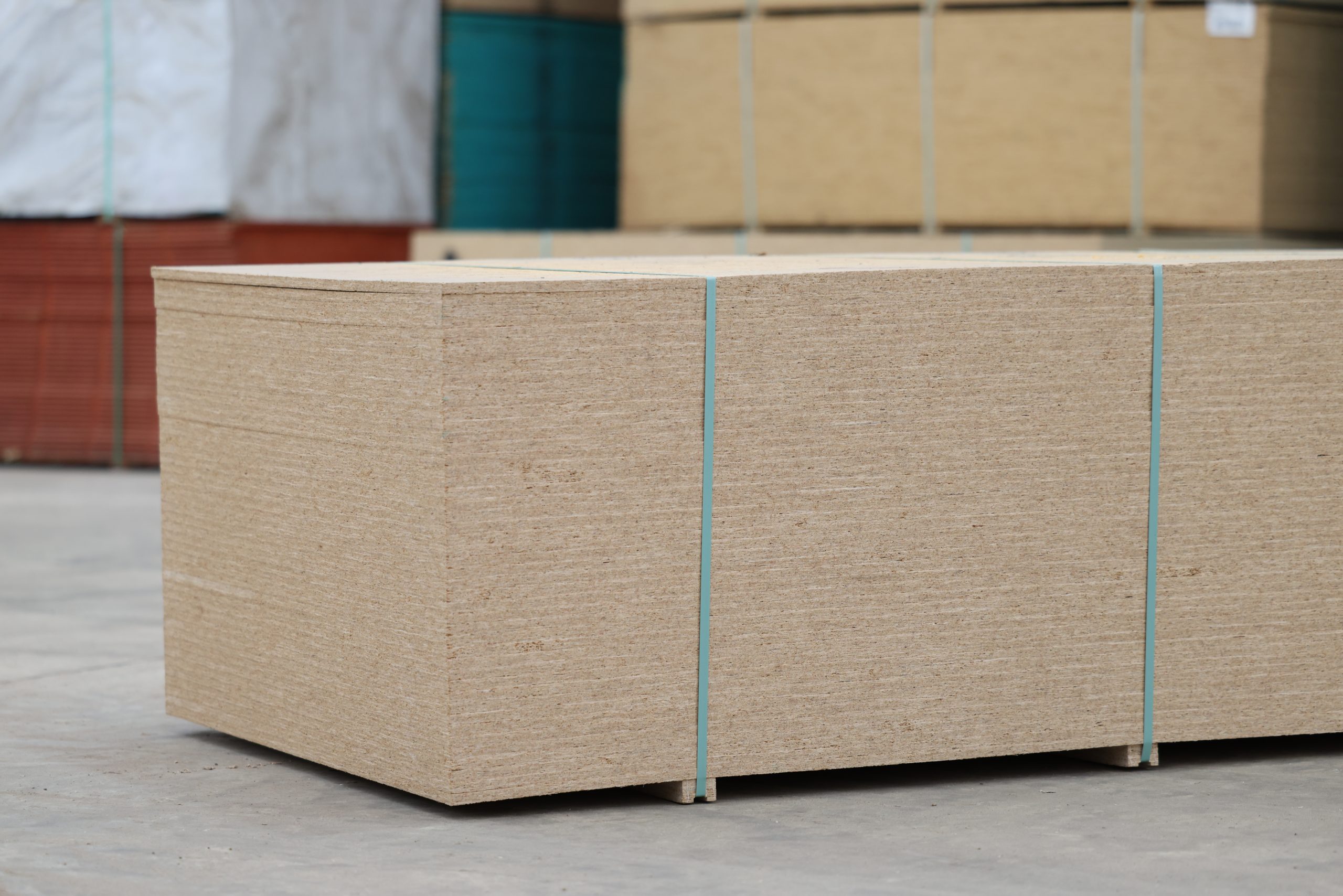
7/16” OSB sold for under $8 a sheet in some areas at the beginning of the year. News of a Southeastern mill slowing production seemed to create a sense of urgency but prices have been historically low and trading quite sluggish. There was very little price movement in OSB in early 2026, similar to much of 2025.
There were a few weeks in the beginning of 2026 where there were reports of many truck loads of OSB selling. Many expected these spikes in demand to finally fluctuate the prices, however, prices continued to remain rather steady for most regions in the US. This tells us that mills’ inventory and production is still much more than the current demand.
Pallet companies are finding ways to innovate (despite, or maybe because of, the difficult pallet market). Greystone Logistics has introduced a “groundbreaking” pallet program called “Palletrip”, which includes a special pallet coupled with rental and lease programs. The pallet itself is a lightweight, recycled plastic pallet that utilizes advanced cellular-based tracking and tracing. What does the cellular device reveal? It monitors several metrics in real time, such as movement history, location, excessive impact, temperature and even dwell time.
This level of technology in pallets likely appeals primarily to large retailers (such as their high-profile customers including names like Walmart, Corning, and Omaha Steaks).
Even in difficult times it is possible to innovate and find a way forward, and this is a case in point. Earlier in the year this company had announced layoffs after one of their major customers suspended orders.
In November and December of 2025 the pallet industry experienced an uptick and went from “fair/steady” to “good”. The holiday season of 2025 was particularly brisk, when you look at sales numbers of the period. For example, online sales hit a record of almost $258 billion, which is nearly 7% higher than the 2024 holiday season. A tracking platform from Mastercard, called “SpendingPulse”, estimated the total retail holiday sales to be about 3.5% higher during the November-December period (excluding auto sales). So there is room for cautious optimism that the pallet industry can pick up in 2026.
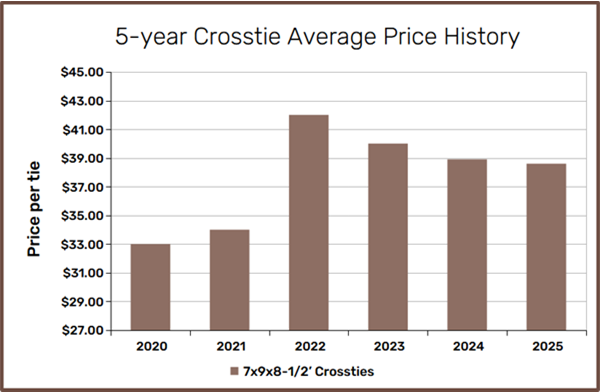
It is interesting to note how many prices spiked during the COVID years as supply chains were interrupted. This chart is one example and we are seeing it across many different sectors and commodities. After COVID, every major hardwood‑using industry—flooring, cabinets, pallet lumber, crane mats, and ties—surged at the same time, all competing for the same logs and driving log and cant prices sharply upward. Replacement activity may or may not have been higher in 2022, but regardless of whether the railroads themselves increased replacement volume, this supply pressure alone forced railroad tie prices to spike in 2022.
The biggest news in the tie industry is the proposed merger between Union Pacific and Norfolk Southern railroads. This has the potential to reshape numerous aspects of the railroad tie industry, including use, production, and delivery. Some large tie producers cut orders in January as they anticipate uncertainty and a drop in demand while these two railroad giants work out a deal. This would be a historic merger that combines 50,000 route miles across 43 states. The details are still in a review process which is expected to end in early 2027, so it isn’t happening immediately.
A combined Union Pacific and Norfolk Southern would control up to 46% of total rail freight which is a huge portion of U.S. rail traffic (almost half). Tie purchasing could move toward larger contracts with preferred suppliers and sawmills that can produce consistent specifications. That could also mean fewer contracts overall. Some areas may see reduced tie demand due to changing freight patterns while other areas may see increased demand along future transcontinental routes.
We will be looking at this proposed merger more in the future.
The Trump Administration has decided to postpone the planned increase in tariffs on imported upholstered furniture, kitchen cabinets, and vanities by one year, facilitating more trade negotiations while keeping the current 25% duty in effect. So the 25% tariffs will most likely remain in effect for 2026. Canada was thankful for the delay, although their economy is still being devastated by the current tariffs.
Several hardwood sawmills have had their railroad tie customers either significantly reduce or outright cancel their tie orders until this summer because of the proposed merger that we already discussed between Union Pacific and Norfolk Southern railroads.
Since crosstie production has propped up many mills during lethargic demand for other commodities, this could prove to be a real problem for some sawmills that were relying on tie orders.
Hardwood sawmill production continues to decline. Here’s the big picture. Average production over the last 66 years was just under 9 billion board feet. The record high for that same time span was just over 12.5 billion board feet in 1999. Contrast those numbers with total output in 2025 which was just over 4 billion board feet and you have half the output that the US has averaged over the last 65+ years.
Much of this is due to reduced demand for hardwood lumber since non-wood lookalikes have exploded in recent years. There are pros and cons for real wood versus the non-wood substitutes, so I can understand why products like poly furniture and plastic decking have become popular. Those items last longer and require less maintenance, especially in outdoor use. But real wood has aesthetic appeal that non-wood lookalikes can’t compete with, and is sustainable and better for the environment.
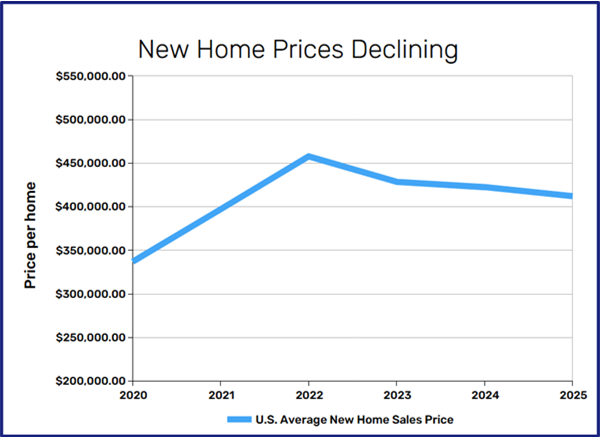
The average price of a new home peaked at almost $458,000 in 2022, once again coinciding with the COVID years. Since that time, prices have been steadily declining. The average price of a new home in 2025 was just over $412,000. This decline, combined with lowering interest rates, is boosting new home sales.
On January 9th the interest rate for a 30-year fixed rate mortgage increased to 6.16%, which is still three quarters of a percent lower than January 2025 (0.77% to be exact, since the interest rate in January of 2025 peaked at 6.93%). This drop comes after the Fed trimmed the interest rates three times in 2025.
The Federal Reserve chose not to decrease interest rates, holding its benchmark federal funds rate steady at 3.5% to 3.75% during its late‑January 2026 meeting, despite prior cuts in 2025. Officials cited solid economic activity, a stabilizing labor market, and still‑elevated inflation as reasons to pause further easing.
Our team at Lumber Link collaborated to share Lumber Notes with you. We enjoy providing mill direct savings to volume lumber users. You can reach us at 606-547-4455 or [email protected]