September 28, 2026 Lumber News
Another week of decreases comes as demand seems to refuse to pick up the pace in nearly all sectors of lumber. The only ...

Lumber Notes May 2026
Welcome to another look at the lumber world!
We have been looking at some of the factors that have contributed to declining lumber production in the Pacific Northwest, and last month we talked about the Spotted Owl and how a conflict erupted between the environmentalists and the loggers, now referred to as the “Timber Wars” of the late 80’s and early 90’s. In this month’s introduction we will be quoting from a famous environmentalist of the era named Judi Bari who was writing and organizing during this time.
Timber Wars: Footloose Wobs Urgently Needed
By Judi Bari, Industrial Worker, October 1989; Reprinted in Timber Wars, © 1994 Common Courage Press.
“You commie hippies, I’ll kill you all!” A shotgun blast goes off and the Earth First!ers scatter. What started as a peaceful logging road blockade had turned violent when a logger sped his truck through our picket line and swerved it towards the demonstrators. The loggers also grabbed and smashed an Earth First!er’s camera and, for no apparent reason, punched a 50-year old protester in the face, breaking her nose. The environmental battle in the Pacific Northwest has reached such a level of intensity that the press now refers to it as the Timber Wars. At stake is the survival of one of the nation’s last great forest ecosystems. Our adversaries are giant corporations–Louisiana Pacific, Georgia Pacific, and MAXXAM in northern California, where I live, joined by Boise Cascade and Weyerhauser in Oregon and Washington.
These companies are dropping trees at a furious pace, clogging our roads no less than 18 hours a day, with a virtual swarm of logging trucks. Even old timers are shocked at the pace and scope of today’s strip-logging, ranging from 1000-year old redwoods, one tree trunk filling an entire logging truck, to six-inch diameter baby trees that are chipped up for the pulp-mills and particleboard plants.
One-hundred-forty years ago the county I live in was primeval redwood forest. At the current rate of logging, there will be no marketable trees left here in 22 years. Louisiana Pacific chairman Harry Merlo put it this way in a recent newspaper interview: “It always annoys me to leave anything lying on the ground. We don’t log to a 10-inch top, we don’t log to an 8-inch top or a 6-inch top. We log to infinity. It’s out there, it’s ours, and we want it all. Now.”
So the battle lines are drawn. On one side are the environmentalists, ranging from the big-money groups like Wilderness Society and Sierra Club to the radical Earth First!ers and local mountain people fighting the front line battles in the woods. Tactics being used include tree-sitting, logging road blockading, and bulldozer dismantling, as well as the more traditional lawsuits and lobbying.
On the other side are the big corporations and the local kulaks who do their bidding. Tactics used by them have included falling trees into demonstrators, suing protesters for punitive damages (and winning), buying politicians, and even attempting to ban the teaching at a local elementary school of a Dr. Suess book, The Lorax, which the timber companies say portrays logging in a bad light.
To be continued next month…
We would be remiss not to tell you about what was happening in low grade this spring. Low grade rose dramatically in price from January through March, closing the gap between it and Std&Btr grade. What factors were driving this hike?
Since there isn’t a lot of profit to be made on the lower grades, producers are reluctant to ramp up production even though there was a steady uptick this spring.[i]
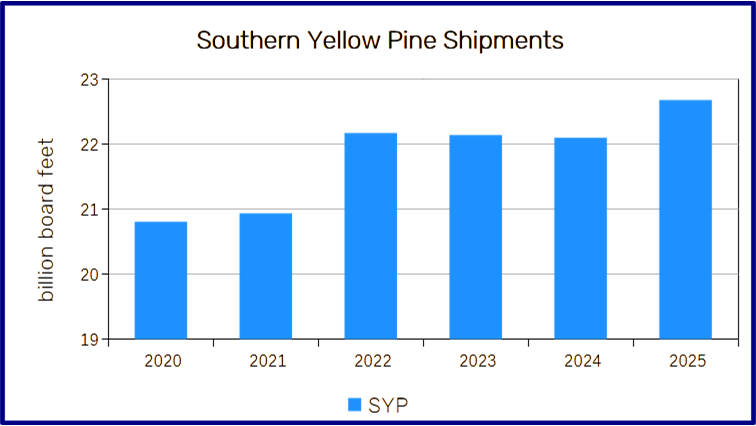
The Southern Yellow Pine market continues to grow, as the above chart shows (figures from the Southern Forest Producers Association (SFPA). SYP exports reached a record 22.7 billion board feet last year. This beat 2022’s record of 22.16 bbf and represents an increase of about 500 million board feet compared to 2024.[i]
The US South looks like a promising region for lumber production as other regions and countries face challenges. More than half of global lumber production growth is expected to come from the United States, with the US South accounting for most of that increase. The region benefits from lower costs, strong timber availability and continued mill investment. [ii]
Contrast the difficulties faced by these regions with the US South:
Here’s a brief look at some production numbers for North America in 2025. Total output in 2025 totaled nearly 56.4 billion board feet, which represents a 1% decline from 2024. US output of just over 37 bbf was actually up 1.2% from the 2024 total, but that gain was more than offset by Canada’s production of almost 19.3 bbf in 2025, which was 5% lower than 2024. This is looking across all species and not Southern Yellow Pine particularly.
In SYP particularly, output actually rose by over 2.5% in 2025, bringing that total in billion board feet to nearly 22.7.
It shouldn’t surprise us that the drop in Canada’s production was led by British Columbia (BC), where just over 6 bbf total production for 2025 represented a decline of nearly 10% compared with the year before. Compare that drop with Eastern Canada, where total output of almost 13.3 bbf was down by nearly 3%. Production in December dragged the totals down for 2025, as output from BC in December of 2025 was only 357 million board feet which was the lowest output for that area in years. This figure is over 20% lower than December of 2024 and shows a decline of over 66% from December of 2015.[v] The volume of lumber available in US markets fell considerably in 2025, even though production was up. This is because the decline in lumber imports from Canada more than made up for the increase of production in the US. Total US imports from Canada in 2025 totaled almost 10.5 bbf, which represents a sharp drop of over 12%. Canada is still the largest importer of lumber into the US, although because of the Trump administration’s push for less reliance on Canadian lumber, and tariffs and the Section 232 ruling, Canada has been trying to establish ties with other trading partners. The goal of less reliance on Canadian imports is more lumber produced in the US, more jobs for US workers, and more stable domestic supply for US housing, among other things.[i]
Below is a brief article about how to calculate fuel surcharges that you may find helpful. Trucking availability and rising fuel prices were problematic this spring and may continue into the summer.
“Some companies have added a fuel surcharge to cope with quickly rising diesel prices. This is an option for pallet companies to consider as margins continue to be squeezed with escalating input costs. The decision to institute a fuel surcharge isn’t something you should take lightly. But it may be time for more pallet companies to consider given the volatility of the fuel market. The Energy Information Agency (EIA) publishes weekly data on diesel fuel price averages. This information is used by companies to calculate price differences. The federal government does not regulate fuel surcharges. Each company is able to calculate whatever rate it wants.
“You can find the EIA’s regular diesel fuel analysis at https://tinyurl.com/nxbz9s5as. So, how do you calculate a fuel surcharge? You first start with setting a base rate. This can be any price depending on what you and your customers consider normal fuel price ranges. At the end of the day, customers don’t have to pay fuel surcharges. But they will if it seems reasonable and they need the product. The lower the base fuel price, the higher the fuel surcharge will be. The following is an example equation that some companies use:
Original fuel price – Updated fuel price = Difference in fuel cost
Difference in fuel cost/Miles per gallon = Cost Per Mile (CPM)
CPM x Distance travelled = Surcharge
For another convenient option, you can use the online calculater at https://tinyurl.com/y3vpr6km.”[i]
[i]“How to Calculate Fuel Surcharges” (Industrial Reporting Inc., Pallet Profile, 3/27/26)
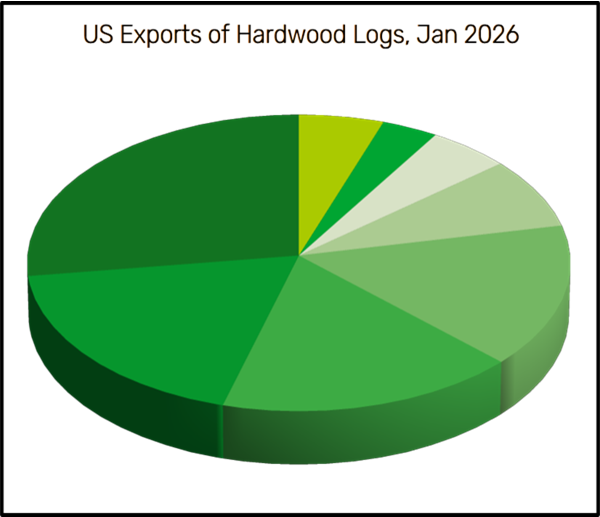
As we can see from the chart above, Walnut logs lead the pack at just over 27% of total exports, with Red Oak, White Oak, and Maple coming in second, third, and fourth in that order. But when you look at US exports of hardwood lumber as opposed to exports of logs, the numbers change. Red Oak takes first place at 250 million board feet, with White Oak following close behind at about 245 mmbf. Poplar comes in third and, surprisingly, Walnut lumber comes in last, at about 75 mmbf.[1]
Since the war in Iran started on February 28, higher fuel prices were disrupting exports, not only to the Middle East but to other areas as well. And fuel prices were not the only problem. New orders pretty well ceased due to uncertainty and increased danger. And Iran heavily restricted the Strait, so many container shipping lines are rerouting their container vessels to avoid the Strait entirely. Soon after the war started, one sawmill operator said that trucking costs had jumped by about $32 per thousand board feet. And depending on the length of the sea voyage, ocean-bound freight costs were up between $100-$300 per container.[2]
Our team at Lumber Link collaborated to share Lumber Notes with you. We enjoy providing mill direct savings to volume lumber users. You can reach us at 606-547-4455 or [email protected]
[1]“Low grades a rare bright spot so far in 2026” (Fastmarkets, YS_03_2026).
[1]“Southern Pine Shipments Reached Record in 2025” (Industrial Reporting Inc., Pallet Profile, 4/3/26)
[1]“North American Lumber Outlook: U.S. South Expands as Supply Tightens Across Key Regions” by Rick LeBlanc (Industrial Reporting Inc., Pallet Profile, 3/27/26)
[1]ibid
[1]ibid
[1]“Drop in fourth quarter output sinks lumber production figures” (Fastmarkets, RL_13_2026).
[1]“Lumber available to US in 2025 fell amid drop in imports” (Fastmarkets, RL_12_2026).
[1]“How to Calculate Fuel Surcharges” (Industrial Reporting Inc., Pallet Profile, 3/27/26)
[1]Fastmarkets, hmr_3_29_26, p. 5
[1]“Following Weak 2025 Results, 2026 Starts Slowly Amid Middle East Conflict” by Michael Connolly (Fastmarkets, HMR_Exec-Apr26)